

Is John Wick’s Bulletproof Suit Real?
Whether you like gratuitous action movies or not, I would be surprised if you were unaware of the John Wick franchise. If you're not, he's a former hitman compelled back into using his lethal skillset for vengeance after the murder of his dog, among other things (a reasonable response, I think). One of the many tools at his disposal during this quest for revenge is a bulletproof custom suit. It's a movie, so it would be natural to think that this is just a "man, wouldn’t that be cool if it were real" sort of addition to the story.
But what if I told you that sort of clothing technology does exist and that you can get it from Capitol Hill Clothiers?
This technology isn't designed for hitmen or revenge journeys, it's designed to protect any individual from most bad actors that might seek to harm them. Our suits are fully made in America using DuPont kevlar lining panels rated at Level IIIA protection (In layman's terms, it'll stop a .44 magnum) and trusted by executive security firms and private citizens alike.
What Does “Bulletproof” Actually Mean?
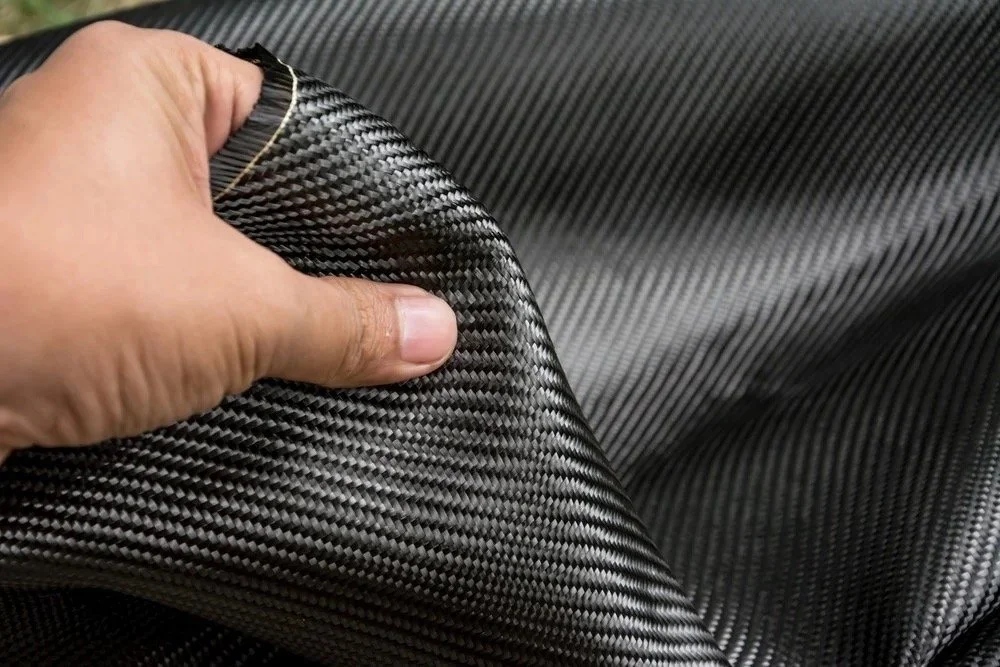
A single layer of Kevlar ballistic material used in Capitol Hill Clothiers bulletproof suits
The National Institute of Justice (NIJ) sets the primary U.S. performance standards that define what “bulletproof” body armor must withstand to be considered reliable for law enforcement and related uses. These standards do not guarantee anything other than exactly which ammunition types, impact velocities, and test conditions armor can survive without allowing a complete penetration or causing life‑threatening blunt trauma to the wearer. Capitol Hill Clothiers uses both Level IIA and Level IIIA ballistics panels in our garments, depending on the client’s request.
What NIJ standards cover
NIJ ballistic standards primarily govern body armor, both soft vests and hard rifle plates, but they also inform testing of helmets and ballistic shields. The standards describe test methods, acceptable back‑face deformation (how far armor can dent inward into the body), environmental conditioning, and the ammunition used for each threat level.
Protection levels and threats
NIJ organizes ballistic protection into levels that correspond to specific handgun and rifle threats, such as common 9 mm handgun rounds up through armor‑piercing rifle cartridges. Earlier versions of the standard used Levels IIA, II, IIIA, III, and IV, while newer documents refine this into handgun (HG) and rifle (RF) categories to better reflect modern threats like intermediate rifle rounds.
How armor is tested
Armor is mounted on a backing material, usually a calibrated clay block, and shot multiple times with specified bullets at controlled velocities from set distances. Testers measure both penetration and back‑face deformation, with deformation typically limited to about 44 mm to reduce the chance of fatal internal injuries even when the bullet is stopped.
Certification and ongoing quality
NIJ standards are tied to a formal compliance program in which independent laboratories test armor models before they are listed as compliant. Manufacturers are subject to follow‑up inspections and periodic re‑testing to ensure that production armor continues to perform at or above the level of the original tested samples.
Why these standards matter
For officers and agencies, NIJ ratings provide a common language to match armor to expected threat environments—for example, soft armor for handgun risks versus hard plates for rifle threats. For designers and builders of “bullet‑resistant” facilities, NIJ levels can be used alongside other standards (such as UL 752) to select glazing, doors, and panels with known performance against defined ballistic threats.
How Bulletproof Suits Work
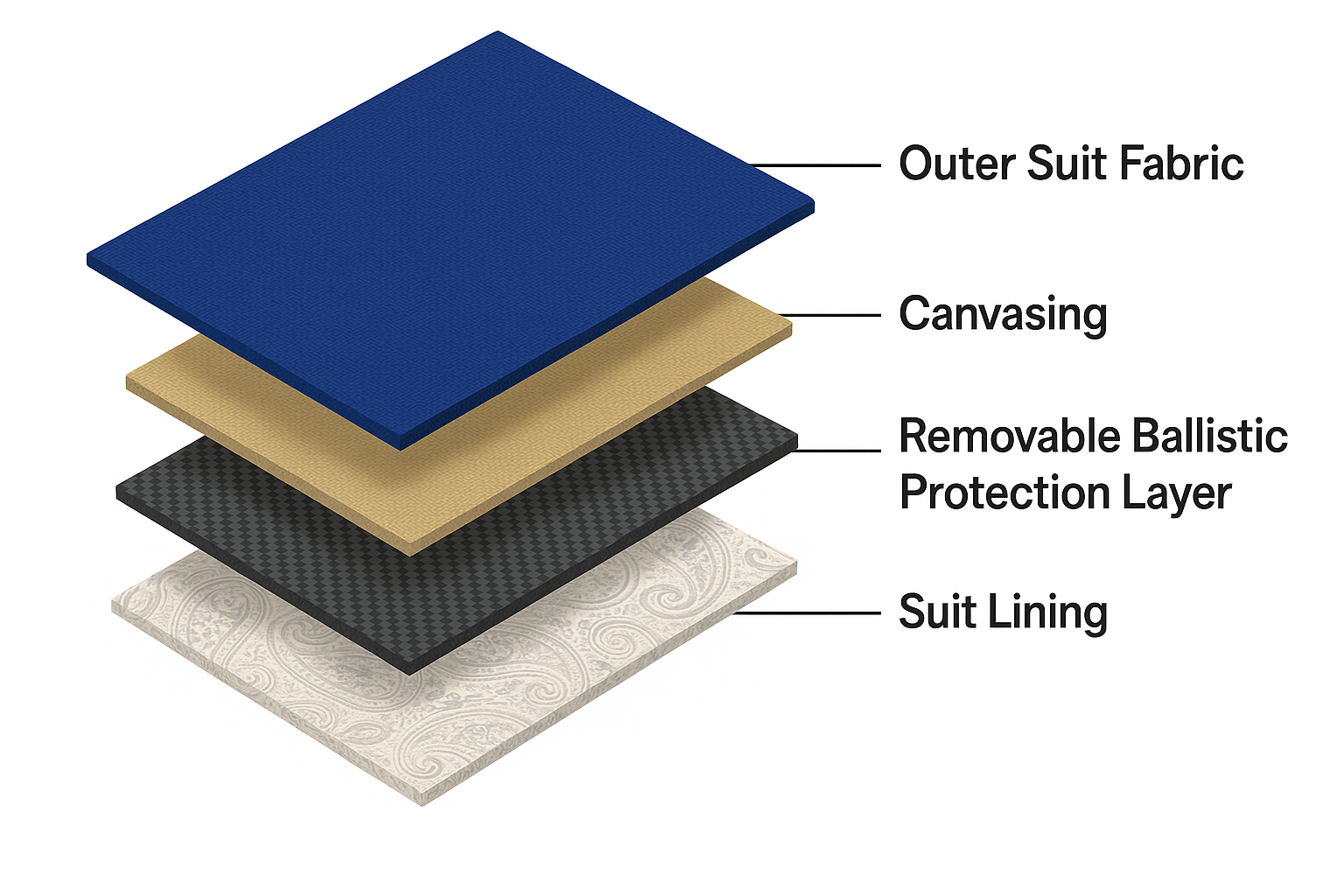
Bulletproof suits work by hiding flexible ballistic panels inside an otherwise normal tailored garment, turning the suit into a wearable armor carrier. The suit fabric itself is not what stops the bullet; instead, it covers and supports layers of advanced fibers (Kevlar in the case of Capitol Hill Clothiers) that catch and slow the projectile, spreading its energy over a wider area to reduce penetration and blunt trauma. The tailoring is adjusted to accommodate these panels while preserving a professional silhouette, so from the outside it still reads as a regular business or formal suit.
Inside the garment, the layered makeup typically starts with an outer shell (wool or wool blend based on client preference), then a durable bemberg internal lining that holds the ballistic inserts, and finally the ballistic package itself, made from many sheets of tightly woven or laminated high‑strength fibers. These sheets are stacked and stitched together, then sealed in a protective cover to shield them from moisture, UV light, and abrasion that could weaken performance over time.
To ensure quality and reliability, we borrow the same principles used in certified body armor: consistent material sourcing, controlled layering processes, and protective covers that prevent environmental degradation of the fibers. Stitching patterns and panel shapes are custom made to order so layers don’t shift with wear, and internal access points allow panels to be cleaned or replaced if damaged.
Capitol Hill Clothiers bulletproof suits are optimized for handgun threats and concealment, not for high‑powered rifle fire, so they trade some protection and coverage compared with bulky overt armor. Comfort‑wise, they are heavier and stiffer than a standard suit but much more wearable and discreet than a plate carrier, especially since our suits and panels are made to order. For care, the suit fabric can often be dry‑cleaned, but the ballistic inserts should be removed beforehand and never machine‑washed; instead, they are wiped down and periodically inspected or replaced according to the maker’s service life guidelines, since ballistic materials can age and gradually lose performance.
How Does a Bulletproof Suit Look?
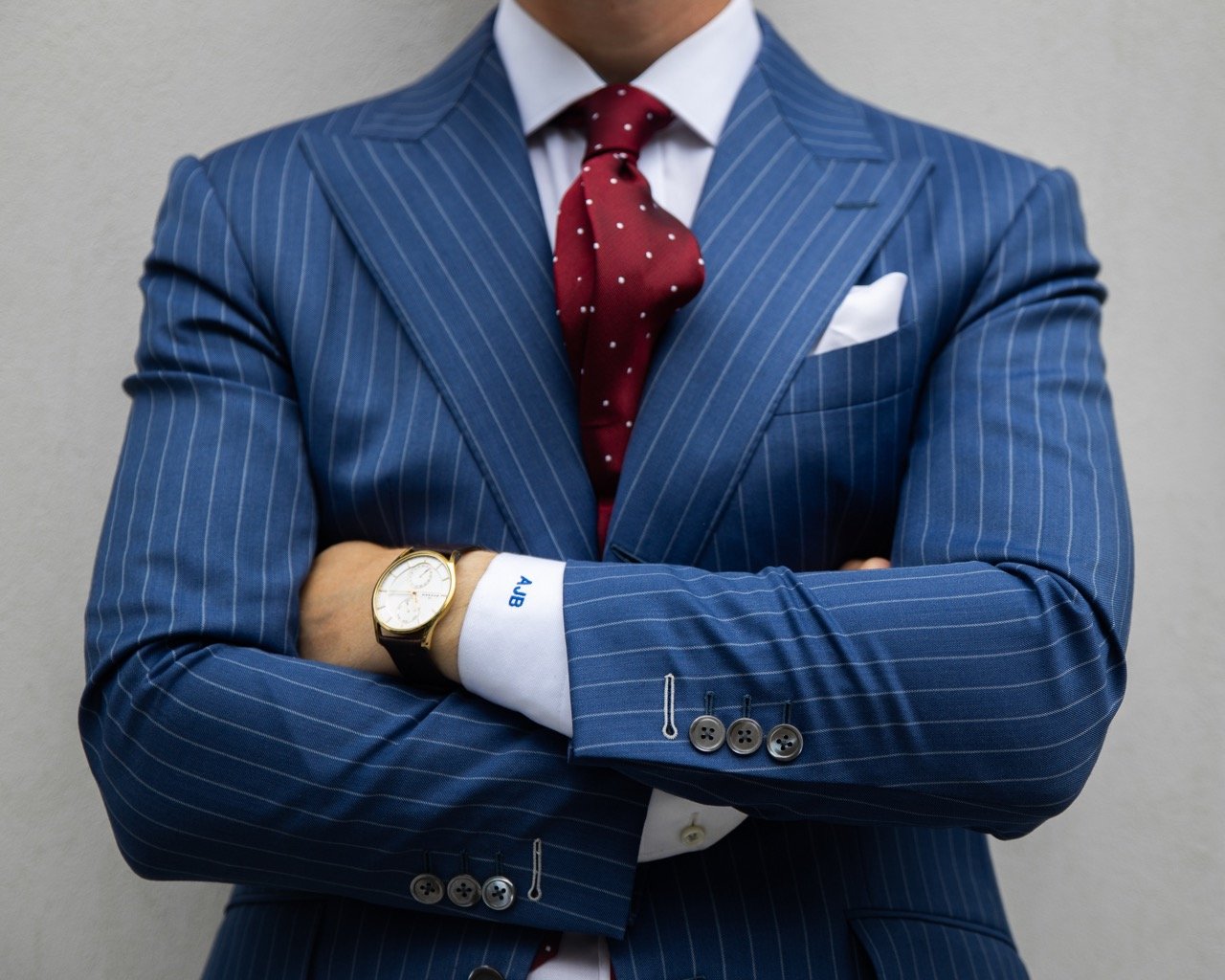
When you look at this suit, do you see anything out of the ordinary? Sure, when wearing a bulletproof suit, you might look a little thicker than you did before putting on the jacket, but you’re a hell of a lot safer. The suit construction relies on a stiffer canvas, reinforced seams, and a more structured chest, which can make the suit feel a bit heavier and less flowing than a purely fashion‑oriented garment, even though it still reads as formal to an outside observer. A bulletproof suit is designed to look as close as possible to a normal tailored suit, so the protective elements are hidden inside rather than worn as an obvious vest over clothing. From the outside, it typically resembles a standard two‑ or three‑piece suit with normal lapels, buttons, pockets, and a smooth drape, made in classic dark colors and business‑appropriate fabrics to avoid drawing attention.
Our bulletproof suit details are also chosen with both aesthetics and function in mind: higher armholes and slightly shorter jacket length help with mobility, and linings are fully closed with discreet zippers so ballistic panels can be removed for cleaning, replacement, or wear without protection.
A “Full Wrap” adds additional panel overlaps beyond just a vest‑like area, integrating ballistic material around the sides and lower back. This comes at the expense of concealability but does offer more protection. The result is clothing that, on a hanger or at a distance, looks like an ordinary business suit, yet up close can feel slightly stiffer, thicker, and more engineered than a traditional high‑end suit.
Novelty Vs. Real-World Use Cases
John Wick is a movie assassin. It would be cool to say you have a “John Wick” suit, but these are engineered and manufactured for real-world protection. Bulletproof garments are used when people need genuine ballistic protection but also need to move, work, or blend into a normal environment. In practice, that means they are most common where security and everyday life intersect rather than on conventional battlefields or solo vigilante activity.
Our main use case is executive and VIP protection. High‑profile business leaders, politicians, and celebrities may wear bulletproof suits, coats, or undergarments during public events, travel, or meetings in unstable regions to reduce risk without looking like they are in armor. Their security details may also use bulletproof garments like discreet vests under suits to keep a professional appearance while adding an extra layer of safety during close‑protection work.
Law enforcement and specialized security units also use bulletproof clothing in situations where overt armor would be too bulky or would escalate tensions. Plainclothes officers, detectives, and security staff in soft‑target locations (such as malls, religious sites, or corporate/college campuses) may wear our concealed ballistic undershirts so they can blend in while still being protected if a threat appears suddenly. For tactical teams, lighter ballistic garments can supplement traditional ones, giving added coverage to areas like the sides or groin without overly restricting movement.
Another important category is civilian use in high‑risk environments. Journalists, aid workers, and NGO staff operating in conflict zones or areas with high rates of shootings sometimes wear bulletproof jackets, suits, or undergarments that look like normal clothing but contain our soft armor panels. Local officials, high‑net‑worth individuals, or people who have received credible threats may also adopt discreet protective clothing for commuting, public appearances, or even daily errands when risk is elevated.
There’s no telling when a threat scenario might occur and Capitol Hill Clothiers feels no shame in being prepared just in case your life is threatened.
If a bulletproof suit is something you or your team need, please consider Capitol Hill Clothiers your concierge protection solution. We will work with you to create custom bulletproof suits for you and your team, or provide a 10% discount on orders of 10 or more bulletproof garments.